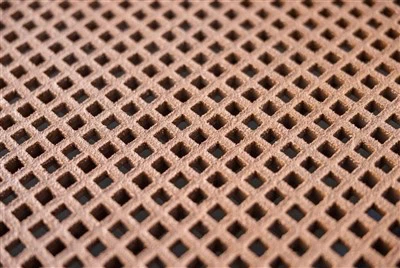
FRP (Fiber Reinforced Polymer) mini mesh grating has become a popular choice in various industries due to its lightweight, high strength, corrosion resistance, and low maintenance requirements. One important property that is often a concern for users is its electrical conductivity. In this blog, as a supplier of FRP Mini Mesh Grating, I will delve into the electrical conductivity characteristics of this product.
Basics of FRP Mini Mesh Grating
First, let's understand what FRP Mini Mesh Grating is. FRP Mini Mesh Grating is a type of grating made from a combination of fibers (such as glass fibers) and a polymer matrix (usually polyester or epoxy resin). The mini - mesh design provides a fine - structured surface, which is suitable for applications where a more delicate or precise grating is required, such as in some laboratory settings, small - scale walkways, or as a protective cover. You can find more details about FRP Mini Mesh Grating on our website.
Electrical Conductivity of FRP
By nature, the polymer matrix used in FRP, like polyester or epoxy resin, is an insulator. These polymers have very high electrical resistance, which means they do not allow an electric current to flow easily through them. The glass fibers typically used in FRP are also insulators. Glass is made up of silicon dioxide and other compounds, and its atomic structure does not have free electrons that can carry an electric charge. So, in general, FRP materials have low electrical conductivity and are considered electrically non - conductive.
This property of low electrical conductivity makes FRP Mini Mesh Grating an excellent choice for applications where electrical insulation is required. For example, in electrical substations, workers need to walk on surfaces that will not conduct electricity in case of accidental contact with live wires. FRP Mini Mesh Grating can be used to construct walkways or platforms in such areas, providing a safe and non - conductive surface. You can explore similar products like GRP Mini Mesh Grating, which also share low electrical conductivity characteristics.
Factors Affecting Electrical Conductivity
However, there are some factors that can influence the electrical conductivity of FRP Mini Mesh Grating.
Additives: Sometimes, additives may be added to the FRP during the manufacturing process. For instance, if carbon fibers or conductive fillers are added, the electrical conductivity of the FRP can increase significantly. Carbon fibers have free electrons that can move and carry an electric charge, so their addition can turn an initially non - conductive FRP material into a semi - conductive or even a conductive one. This may be desirable in some applications where static electricity dissipation is required. Products like FRP Micro Mesh Grating may have different additive options, which in turn affect their electrical conductivity.
Environmental Conditions: The environment in which the FRP Mini Mesh Grating is used can also affect its electrical conductivity. In a humid environment, moisture can accumulate on the surface of the grating. Water can act as a conductor to some extent, especially if there are impurities or dissolved salts in it. So, over time, in a damp or wet environment, the apparent electrical conductivity of the grating may increase slightly. Similarly, if the grating is exposed to chemicals that can react with the polymer matrix or the fibers, it may change the structure of the material and potentially affect its electrical properties.
Measuring Electrical Conductivity
There are standard methods to measure the electrical conductivity of FRP materials. One common approach is to use a four - point probe method. In this method, four electrodes are placed on the surface of the sample. A current is passed through the outer two electrodes, and the voltage is measured across the inner two electrodes. Using Ohm's law (V = IR), the resistance of the sample can be calculated, and from the resistance and the dimensions of the sample, the electrical conductivity can be determined.
Applications Based on Electrical Conductivity
The electrical conductivity property of FRP Mini Mesh Grating determines its suitability for different applications.


Non - Conductive Applications: As mentioned earlier, in electrical and electronic industries, non - conductive FRP Mini Mesh Grating is used for walkways, cable trays, and equipment enclosures. It helps prevent electrical short - circuits and protects workers from electric shocks. In the food and beverage industry, where hygiene and electrical safety are both important, non - conductive FRP Mini Mesh Grating can be used for platforms and catwalks. You can find relevant products for such applications in our FRP Walkway Grating category.
Conductive Applications: When static electricity is a concern, such as in the manufacturing of electronic components or in areas where flammable gases are present, conductive FRP Mini Mesh Grating (with additives) can be used. The static electricity can be safely dissipated through the grating, reducing the risk of electrostatic discharges that could cause fires or damage to sensitive electronic equipment. If you are interested in conductive micro - structured grating, you can look at our Micro Mesh Grating.
Why Choose Our FRP Mini Mesh Grating
As a supplier, we take pride in providing high - quality FRP Mini Mesh Grating with well - controlled electrical conductivity properties. We ensure that our manufacturing process follows strict quality standards, so whether you need a non - conductive or a conductive grating, we can meet your requirements precisely. Our products are not only tested for electrical conductivity but also for other important properties such as strength, corrosion resistance, and fire retardancy.
If you are in need of FRP Mini Mesh Grating for your specific project, whether it's for a non - conductive or a conductive application, feel free to reach out to us. We are ready to discuss your needs, provide detailed product information, and offer competitive pricing. We believe that our FRP Mini Mesh Grating can be an ideal solution for your electrical - safety and structural - support requirements.
References
- Katz, J. V., & Milewski, J. V. (Eds.). (1987). Handbook of fiber - reinforced plastics. Van Nostrand Reinhold.
- Mallick, P. K. (2007). Fiber - reinforced composites: materials, manufacturing, and design. CRC press.