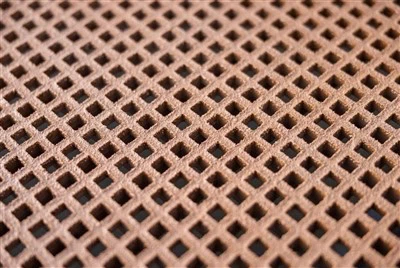
As a supplier of FRP Mesh Grating, I am often asked about the key properties of our products, one of the most critical being their resistance to UV radiation. In this blog post, I'll delve into the science behind how FRP Mesh Grating effectively withstands the harsh effects of UV exposure, a feature that makes it an ideal choice for various applications.
Understanding UV Radiation Threats
UV radiation from the sun is divided into several categories, with UV - A, UV - B, and UV - C being the most well - known. While the ozone layer effectively filters out most of the harmful UV - C rays, UV - A and UV - B still reach the Earth's surface and can cause significant damage to materials over time.
For many common materials, especially plastics and some metal composites, prolonged exposure to UV radiation leads to a range of problems. Plastics may become brittle, fade in color, and develop cracks, eventually losing their structural integrity. Metals can suffer from accelerated corrosion, particularly in the presence of moisture and other environmental contaminants.
The Composition of FRP Mesh Grating
FRP, or Fiber - Reinforced Plastic, is a composite material made up of a polymer matrix reinforced with fibers, typically glass fibers. The polymer matrix is usually a thermosetting resin, such as polyester, vinyl ester, or epoxy. Each of these components plays a crucial role in the grating's ability to resist UV radiation.
The glass fibers in FRP Mesh Grating provide excellent mechanical strength. They act as the backbone of the material, distributing loads evenly across the structure. These fibers are inherently resistant to UV radiation. Glass does not absorb UV light in the same way that many polymers do, so it retains its strength and properties even after long - term exposure to the sun.
The polymer matrix, on the other hand, is initially more vulnerable to UV damage. However, through careful formulation and the addition of specific additives, its performance can be significantly enhanced.
Additives for UV Resistance
One of the primary ways we enhance the UV resistance of our FRP Mesh Grating is by incorporating UV stabilizers into the polymer matrix. These stabilizers work in different ways to protect the resin from the harmful effects of UV radiation.
UV Absorbers
UV absorbers are a common type of additive. They work by absorbing the UV light and converting the absorbed energy into heat, which is then dissipated. This prevents the UV energy from causing chemical reactions within the polymer matrix that could lead to degradation. For example, benzophenone - based and benzotriazole - based UV absorbers are often used in FRP products. They have high absorption coefficients in the UV - A and UV - B regions, effectively shielding the resin from the most damaging wavelengths of UV light.
Hindered Amine Light Stabilizers (HALS)
HALS are another important class of additives for UV protection. Unlike UV absorbers, HALS do not directly absorb UV light. Instead, they act as radical scavengers. When UV radiation hits the polymer matrix, it can generate free radicals, which are highly reactive chemical species that can break the polymer chains. HALS react with these free radicals and neutralize them, preventing the chain - scission reactions that would otherwise lead to the weakening and degradation of the material.
Pigments
Pigments are often added to FRP Mesh Grating not only for aesthetic purposes but also for their UV - blocking properties. Inorganic pigments, such as titanium dioxide, are particularly effective in this regard. Titanium dioxide can scatter and reflect UV light, reducing the amount of UV energy that penetrates the polymer matrix. This not only helps to protect the resin but also contributes to the long - term color stability of the grating, preventing it from fading over time.
Surface Treatments for Enhanced Protection
In addition to the additives in the polymer matrix, surface treatments can also be used to further improve the UV resistance of FRP Mesh Grating.
Gel Coats
Applying a gel coat is a common surface treatment method. Gel coats are thin layers of resin that are applied to the surface of the grating during the manufacturing process. The gel coat can be formulated with high concentrations of UV stabilizers and pigments, providing an extra layer of protection against UV radiation. It also gives the grating a smooth and aesthetically pleasing surface finish.
Topcoats
Topcoats are similar to gel coats but are typically applied after the grating has been molded. They can be used to enhance the UV resistance of the grating, as well as to improve its chemical resistance, scratch resistance, and overall durability. Some topcoats are specifically designed to provide long - term protection against the harsh outdoor environment, including UV exposure.
Real - World Performance and Applications
The ability of FRP Mesh Grating to resist UV radiation makes it suitable for a wide range of outdoor applications.
Industrial Gratings
In industrial settings, FRP Mesh Grating can be used for walkways, platforms, and stair treads. These areas are often exposed to direct sunlight, and traditional metal gratings may corrode quickly under UV and environmental conditions. FRP Mesh Grating, with its excellent UV resistance, can maintain its structural integrity and appearance over a long period, reducing the need for frequent replacement and maintenance.
GRP Moulded Grating
GRP (Glass - Reinforced Plastic) Moulded Grating is a type of FRP grating that is widely used in marine applications, such as docks, piers, and offshore platforms. In these environments, the grating is exposed to both UV radiation and saltwater, which can be extremely corrosive. The UV - resistant properties of FRP ensure that the grating can withstand the sun's rays while also being resistant to the corrosive effects of saltwater.
Open Mesh Grating
Open Mesh Grating is often used in areas where drainage and ventilation are important, such as in wastewater treatment plants and chemical processing facilities. These outdoor facilities are constantly exposed to the elements, including UV radiation. The ability of FRP Open Mesh Grating to resist UV damage means that it can continue to function effectively over time without losing its strength or structural properties.
FRP Floor Grating
FRP Floor Grating is used in various pedestrian and light - traffic areas, such as rooftop walkways and public plazas. The UV resistance of the grating ensures that it maintains its color and surface properties, providing a safe and attractive flooring solution for outdoor spaces.


Contact Us for Your FRP Mesh Grating Needs
If you are in the market for high - quality, UV - resistant FRP Mesh Grating, we are here to help. Our team of experts can provide you with detailed information about our products, answer any technical questions you may have, and work with you to find the best solution for your specific application. Please reach out to us to start a discussion about your procurement needs.
References
- Morgan, R. (2018). "Advanced Composite Materials for Structural Engineering." CRC Press.
- Mallick, P. K. (2007). "Fiber - Reinforced Composites: Materials, Manufacturing, and Design." CRC Press.
- Ratner, B. D., Hoffman, A. S., Schoen, F. J., & Lemons, J. E. (Eds.). (2004). "Biomaterials Science: An Introduction to Materials in Medicine." Academic Press.