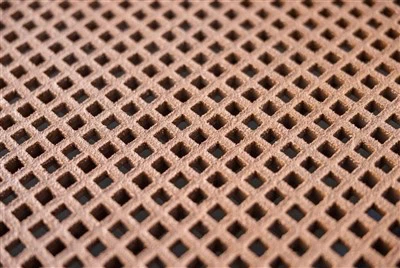
As a supplier of FRP Rectangular Mesh Grating, I often get asked about the coefficient of friction of our product. This is a crucial property, especially when considering the safety and functionality of the grating in various applications. In this blog, I'll delve into what the coefficient of friction is, how it's relevant to FRP Rectangular Mesh Grating, and what factors can influence it.
Understanding the Coefficient of Friction
The coefficient of friction is a numerical value that represents the ratio of the force of friction between two surfaces to the normal force pressing them together. It's denoted by the Greek letter μ (mu). There are two main types of coefficients of friction: static and kinetic. The static coefficient of friction (μs) applies when the two surfaces are at rest relative to each other, and it determines the minimum force required to start moving one surface over the other. The kinetic coefficient of friction (μk), on the other hand, comes into play when the surfaces are in motion relative to each other and is generally lower than the static coefficient.
In the context of FRP Rectangular Mesh Grating, the coefficient of friction is a measure of how much grip the grating provides underfoot. A higher coefficient means better traction, which is essential for preventing slips and falls, especially in environments where the surface may be wet, oily, or contaminated.
Importance of Coefficient of Friction in FRP Rectangular Mesh Grating
FRP Rectangular Mesh Grating is widely used in industrial settings, walkways, platforms, and other areas where safety is a top priority. In these environments, workers may be carrying heavy loads, walking quickly, or operating machinery, all of which increase the risk of slips and falls. A grating with a high coefficient of friction can significantly reduce this risk by providing a stable and secure surface for people to walk on.
For example, in a chemical plant where spills are common, a grating with good traction can prevent workers from slipping on the wet or oily surface. Similarly, in a food processing facility, where hygiene is crucial and the floors are regularly washed down, an FRP Rectangular Mesh Grating with a high coefficient of friction can ensure the safety of employees even when the surface is wet.


Factors Affecting the Coefficient of Friction of FRP Rectangular Mesh Grating
Several factors can influence the coefficient of friction of FRP Rectangular Mesh Grating. These include:
Surface Texture
The surface texture of the grating plays a significant role in determining its coefficient of friction. A rough or textured surface provides more contact points between the shoe or foot and the grating, increasing the friction. Our FRP Rectangular Mesh Grating is available in different surface finishes, such as gritted or smooth. The gritted surface finish has small particles embedded in the resin, which creates a rough texture and enhances the traction.
Resin Type
The type of resin used in the manufacturing of the FRP grating can also affect its coefficient of friction. Different resins have different surface properties, and some may provide better grip than others. For example, a resin with a higher hardness may be more resistant to wear and tear, but it may also have a lower coefficient of friction compared to a softer resin. At our company, we carefully select the resin based on the specific requirements of the application to ensure optimal performance.
Contaminants
The presence of contaminants on the surface of the grating can significantly reduce its coefficient of friction. Oil, grease, water, and other substances can act as lubricants, making the surface slippery. Regular cleaning and maintenance of the grating are essential to remove these contaminants and maintain a high coefficient of friction. We recommend using appropriate cleaning agents and methods to ensure the longevity and safety of the grating.
Load and Pressure
The amount of load and pressure applied to the grating can also influence its coefficient of friction. Higher loads can cause the surface of the grating to deform slightly, which may affect the contact between the shoe and the grating and reduce the friction. However, our FRP Rectangular Mesh Grating is designed to withstand heavy loads and maintain its structural integrity, ensuring consistent performance even under high pressure.
Measuring the Coefficient of Friction of FRP Rectangular Mesh Grating
There are several methods for measuring the coefficient of friction of a surface, including the use of a tribometer. A tribometer is a device that measures the force of friction between two surfaces as they slide or roll against each other. The results of the measurement are typically reported as a coefficient of friction value.
In the case of FRP Rectangular Mesh Grating, the coefficient of friction is usually measured under standard test conditions, such as dry or wet surfaces. These measurements provide valuable information about the performance of the grating and can help customers make informed decisions when selecting the appropriate product for their application.
Comparing FRP Rectangular Mesh Grating with Other Types of Gratings
When it comes to choosing a grating for a particular application, it's important to compare the coefficient of friction of different types of gratings. FRP Rectangular Mesh Grating offers several advantages over traditional materials such as steel and aluminum.
Compared to steel grating, FRP grating has a higher coefficient of friction, especially when the surface is wet. Steel grating can become slippery when exposed to water or oil, increasing the risk of slips and falls. In contrast, the surface texture and resin properties of FRP grating provide better traction, even in wet conditions.
Aluminum grating also tends to have a lower coefficient of friction compared to FRP grating. Aluminum is a smooth and non-porous material, which can make it slippery when wet. FRP grating, on the other hand, can be designed with a textured surface to enhance the grip and improve safety.
Applications of FRP Rectangular Mesh Grating Based on Coefficient of Friction
The high coefficient of friction of FRP Rectangular Mesh Grating makes it suitable for a wide range of applications. Some of the common applications include:
Industrial Walkways and Platforms
In industrial settings, workers need a safe and stable surface to walk on. FRP Rectangular Mesh Grating provides excellent traction, even in areas where there may be spills or contaminants. It is also resistant to chemicals, corrosion, and UV radiation, making it a durable and long-lasting solution for industrial applications.
Food and Beverage Industry
In the food and beverage industry, hygiene and safety are of utmost importance. FRP Rectangular Mesh Grating can be easily cleaned and sanitized, and its high coefficient of friction ensures the safety of employees in wet and slippery environments. It is also non-toxic and does not contaminate food products, making it a suitable choice for food processing facilities.
Marine and Offshore Applications
In marine and offshore environments, the grating is exposed to harsh conditions such as saltwater, waves, and high winds. FRP Rectangular Mesh Grating is corrosion-resistant and has a high coefficient of friction, making it a reliable choice for decking, walkways, and platforms on boats, ships, and offshore structures.
Conclusion
The coefficient of friction is a critical property of FRP Rectangular Mesh Grating, as it directly affects the safety and functionality of the product. Our FRP Rectangular Mesh Grating is designed to provide a high coefficient of friction, ensuring excellent traction and preventing slips and falls in various applications. By understanding the factors that influence the coefficient of friction and choosing the right surface finish and resin type, we can offer our customers a customized solution that meets their specific needs.
If you're interested in learning more about our FRP Rectangular Mesh Grating or have any questions about the coefficient of friction, please don't hesitate to contact us. We're here to help you make the right choice for your project and ensure a safe and reliable solution.
References
- ASTM D2047 - Standard Test Method for Static Coefficient of Friction of Polish-Coated Floor Surfaces as Measured by the James Machine
- ISO 13287 - Footwear - Test methods for outsoles - Coefficient of friction