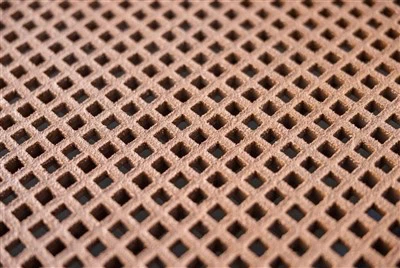
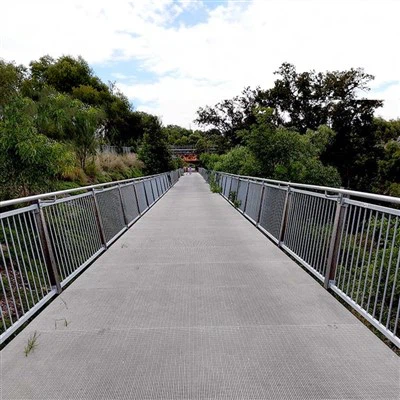
Slip resistance and safety are core requirements for sidewalk materials, and fiberglass gratings excel in this regard. Their surface features a non-slip, textured design, effectively increasing friction underfoot even in rainy, wet, or oily conditions, significantly reducing the risk of slips and falls. At the same time, walkway frp grating have good light transmission and drainage properties; the gaps between the gratings quickly drain rainwater and standing water, preventing puddles and further ensuring pedestrian safety. Compared to traditional concrete sidewalks, they do not require additional drainage slopes, making construction more convenient and reducing water erosion of the road surface. Compared to steel gratings, they do not become smooth due to oxidation and rust, providing longer-lasting safety.

Corrosion resistance and durability are another major advantage of fiberglass gratings. In special environments such as industrial parks, chemical parks, and coastal areas, traditional steel gratings are susceptible to acid and alkali corrosion and salt spray erosion, typically lasting only 3-5 years; concrete sidewalks are prone to cracking and spalling. Fiberglass gratings, however, have extremely strong corrosion resistance, resisting erosion from various chemical media such as acids, alkalis, salts, and solvents. In high-salt spray coastal and highly corrosive chemical environments, their service life can reach 15-20 years. Furthermore, they are non-conductive and non-magnetic, avoiding safety hazards such as electric shock and magnetic field interference in sidewalk scenarios near power facilities and precision instruments, making them suitable for a wider range of applications.
Lightweight and high strength are significant advantages of walkway frp grating, greatly facilitating construction and transportation. Their density is only 1/4 that of steel, and under the same load-bearing capacity, their weight is far less than traditional materials, reducing logistics costs. They do not require large lifting equipment; they can be laid manually, significantly improving construction efficiency and shortening construction time. At the same time, their excellent mechanical properties meet conventional load-bearing requirements, and the thickness and aperture can be customized according to different traffic scenarios, adapting to diverse needs.
In addition to its practical performance, fiberglass grating also boasts excellent environmental and economic benefits. Its production process is energy-efficient, and the material is recyclable, avoiding the destruction of forest resources compared to wood products. It has a long service life and low maintenance costs, eliminating the need for regular rust removal, painting, and repairs, significantly reducing overall costs over the long term. Currently, this material is widely used in various applications, including sidewalks on urban main roads, walkways in industrial parks and workshops, walkways in sewage treatment plants, scenic viewing platforms, and bridge pedestrian walkways, becoming an important material choice for improving infrastructure quality and reducing operating and maintenance costs.
With the advancement of green building and smart city concepts, walkway frp grating for sidewalks have a broad market prospect due to their comprehensive advantages of safety, durability, environmental friendliness, and cost-effectiveness. Whether for large-scale municipal construction or small-scale walkway renovations, it can adapt to various needs and perform reliably, providing pedestrians with a safe and comfortable passage experience while reducing long-term maintenance pressure for construction units. It is an ideal choice for upgrading sidewalk materials in the new era.
Hot Tags: walkway FRP grating, China walkway FRP grating manufacturers, suppliers, factory