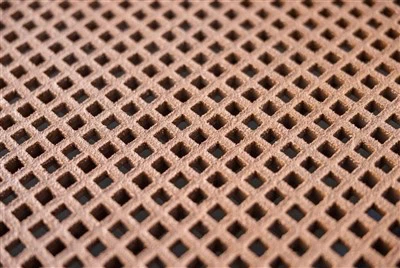
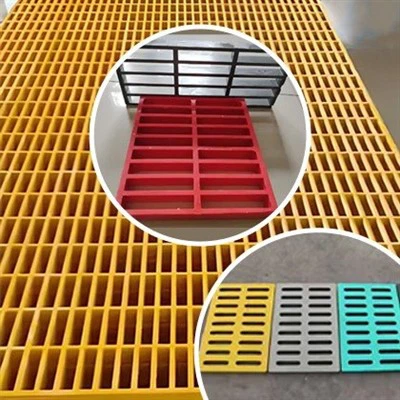
- GRP pultruded grating is a grid-like structural panel manufactured using continuous glass fiber rovings and high-performance thermosetting resins (such as orthophthalic, isophthalic, and vinyl ester resins) as core raw materials, through a pultrusion molding process. The manufacturing process involves fully impregnating the glass fiber rovings with resin, then using a pulling device to draw the impregnated fiber bundles into a specific mold. After heating and curing, the material is pultruded into shape, and finally assembled to form a grating product with a regular grid structure.
- Structurally, the grating mainly consists of three parts: first, load-bearing profiles, usually pultruded "I" or "T" profiles, which are the core components for bearing loads; second, connecting profiles, mostly pultruded round or shaped rods, responsible for connecting the load-bearing profiles and ensuring structural integrity; and third, spacing profiles, also pultruded rods, used to adjust and fix the void ratio of the grating to meet different application requirements. This modular structural design ensures the structural stability of the grating and facilitates customized production.


Advantages
GRP pultruded grating stands out due to its comprehensive performance breakthroughs. Compared with traditional materials, it exhibits many irreplaceable advantages:
This grating is lightweight and easy to handle, significantly reducing labor and material costs during transportation and installation. Despite its light weight, its strength is not compromised-the pultrusion process creates a continuous reinforced structure of glass fibers in the load-bearing direction, resulting in strength far exceeding that of ordinary steel; it also has excellent fatigue resistance, effectively reducing the number of support structures needed in large-span applications, thus lowering overall project costs. For example, in industrial platform construction, a single worker can carry a standard-sized grating panel, while a steel grating of the same size would require multiple people or tools, resulting in significantly improved installation efficiency.
Corrosion resistance is one of the core advantages of GRP pultruded grating. The composite material structure formed by its resin matrix and glass fibers effectively prevents the penetration of various corrosive media such as acids, alkalis, salts, organic solvents, seawater, and corrosive gases. Even in extreme acid and alkali environments, it maintains structural stability and never rusts. Professional testing has shown that the grating maintains stable performance after immersion in corrosive solutions, far exceeding industry standards. This characteristic gives it a long service life in highly corrosive environments such as chemical workshops, sewage treatment plants, offshore platforms, and coastal facilities, while traditional steel gratings have a shorter lifespan and require frequent anti-corrosion maintenance in the same environments.
The grating surface can be embedded with anti-slip particles suchs as quartz sand, providing excellent anti-slip performance and effectively preventing personnel from slipping. At the same time, it has excellent insulation properties, avoiding the risk of electric shock in live work environments; in flammable and explosive environments, its characteristics of not generating friction sparks and not causing electrostatic reactions significantly reduce safety hazards. In addition, some products, through the addition of flame retardants, can meet high-standard flame retardant requirements, complying with the safety regulations of high-risk industries such as petrochemicals.
During the production process, the energy consumption of grp pultruded grating is far lower than that of steel production, and it generates almost no pollutants; the glass fibers in the raw materials are recyclable, conforming to modern green and environmentally friendly concepts. At the same time, its high porosity not only ensures good ventilation and drainage performance, allowing for rapid drainage of accumulated water and waste in car washes and farms, but also reduces material usage, further lowering resource consumption.
Typical cases show that after a large chlor-alkali production park in North China introduced this grating, the equipment corrosion rate decreased significantly, saving a large amount of maintenance and replacement costs annually; a photovoltaic power station in Northwest China used it for its inspection walkways, and after long-term outdoor use, its performance showed no degradation, and its insulation properties avoided the risk of lightning strikes.
As global industries increasingly demand green, low-carbon, safe, efficient, and long-term stable solutions, the market demand for fiberglass pultruded gratings continues to grow. As a corrosion-resistant material recommended in national standard design drawings, it not only helps companies reduce maintenance costs and improve operational safety but also promotes the sustainable development of infrastructure construction.
FAQ
Q: Is fiberglass pultruded grating an environmentally friendly and safe material? Does it produce harmful substances during use?
A: It is an environmentally friendly and safe material. Its raw materials, fiberglass and thermosetting resin, are both non-toxic and environmentally friendly. No harmful gases are emitted during the production process, and the material is recyclable. Under normal operating conditions, the grating structure is stable and will not release harmful substances, fully complying with environmental and safety standards for industrial and civil applications. It can be safely used in areas with high environmental requirements, such as food processing auxiliary areas and municipal public facilities.
Q: How to select the appropriate fiberglass pultruded grating?
A: Selection should be based on the core needs of the application scenario: First, clarify the working environment, such as the presence of corrosive media and whether it is exposed to the outdoors for extended periods, to determine the resin type (ordinary resin is suitable for conventional environments, and corrosion-resistant resin is suitable for chemical/wastewater scenarios); second, based on the load-bearing requirements and the weight of personnel and equipment in the usage area, select the corresponding grating thickness and mesh specifications; finally, consider the installation space dimensions. Customized grating panels of different sizes can be provided to ensure a perfect fit.
Q: What are the precautions for logistics and transportation of fiberglass pultruded grating? Will the manufacturer provide relevant guarantees?
A: Key precautions for logistics and transportation include: First, protection: the grating panels need to be covered with film and packaged to prevent surface scratches or contamination during transportation. For long-distance transportation, dedicated vehicles or customized racks should be used for securing the goods to prevent damage caused by bumps; second, size compatibility: for oversized gratings, the transportation route needs to be planned in advance to confirm any restrictions on bridges, tunnels, etc., along the way. Most reputable manufacturers will provide logistics guarantee services: they will be responsible for coordinating the logistics plan and selecting cooperative logistics companies with qualifications for transporting large items; they will ensure standardized packaging and protection before transportation; and they will track the logistics status throughout the transportation process. If the product is damaged due to transportation, the manufacturer will be responsible for coordinating repairs, replacements, or compensation to ensure the safe delivery of the goods.
Hot Tags: GRP pultruded grating, China GRP pultruded grating manufacturers, suppliers, factory